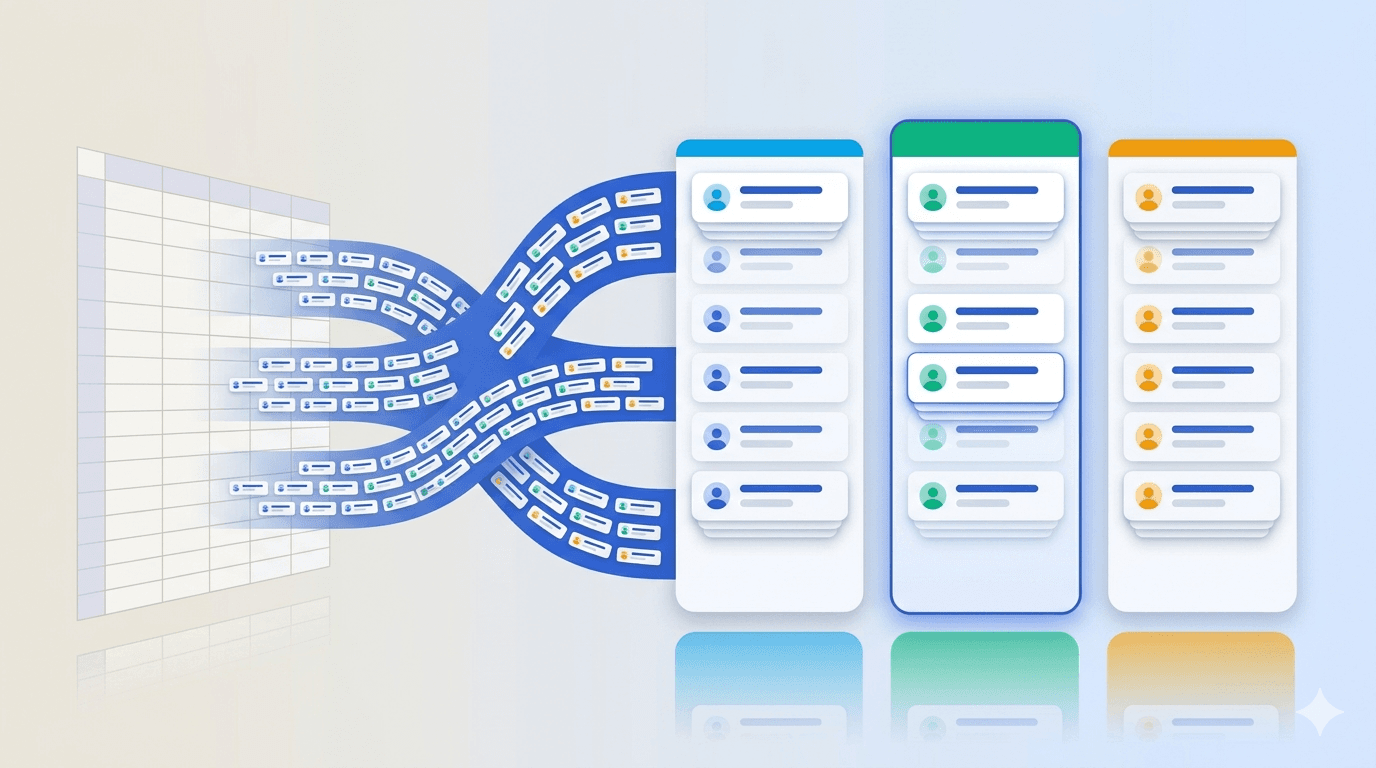

A small recruitment agency in 2026 has two software options on paper and three in reality. The paper options are enterprise agency platforms (Bullhorn, JobAdder, Vincere) or a spreadsheet. The third is a generalist small-team ATS used in an agency-shaped way — most of the operational lift at a fraction of the price.
What does a "small recruitment agency" actually mean?
For the purposes of this post, a small recruitment agency is one to five recruiters running fewer than 20 active client searches at any time, with no in-house engineering team and no procurement-led software process. This is the segment where enterprise agency software is over-built and a spreadsheet is under-built. According to Staffing Industry Analysts and Bullhorn's own recurring industry research, small agencies in this band are a meaningful and growing share of the recruitment market, particularly in tech, healthcare, and creative verticals.
The constraint is not feature parity. It is fit. A solo recruiter does not need a hiring-manager client portal, multi-currency placement-fee tracking, or a full CRM with sequencing. They need a working pipeline, fast candidate screening, a database that compounds across searches, and a place to point inbound applicants. A generalist applicant tracking system (an ATS — software for managing applicants from application through hire) gives them all four, usually at one-tenth the price.
NOTE — Where this post does not apply If your agency has dedicated procurement, more than 5 recruiters, or contractual obligations to surface client-facing portals or audit trails, the workarounds in this post will not be enough. Above that size, agency-specific software is the right answer. This post is for the segment below it.
How do you structure an agency workflow inside a generalist ATS?
Four moves cover almost all of it.
The first is one active job per client search. Name the job with both the client name and the role title — "Acme Co — Senior Backend Engineer" — so the active-jobs list reads like a list of your live searches. Use tags to mark the client name and the recruiter who owns the search. When a search closes (placed or cancelled), archive the job; never delete it.
The second is a single agency-branded career page that lists every active client search. Most generalist ATS tools ship a career page at a custom slug, with one role page per active job. For an agency, this becomes "our open searches" — the indexable surface that captures inbound passive talent. Candidates apply to the agency, the agency routes them to the client.
The third is AI screening on every applicant, every search. This is where small agencies win on volume against larger competitors who still triage manually. AI screening that returns a rating and a reasoning paragraph on every applicant shifts the recruiter's time from reading 100 resumes to reading 100 reasoned summaries — and reading reasoning takes 10 seconds where reading a resume takes 90.
The fourth is deliberate tagging on every candidate record. Skills, seniority, geography, last-active date. The tagging is what turns the database from a graveyard of old applicants into a sourcing surface for new searches. The agency that tags consistently sources ~30 percent of its placements from its own database after the first 200 candidates; the agency that does not, sources zero.
What does an agency-shaped workflow look like, side by side?
| Workflow surface | Enterprise agency platform | Generalist ATS (agency-shaped) |
|---|---|---|
| Pipeline per client search | Yes | Yes (one job per search) |
| Custom pipeline stages | Yes | Yes |
| AI candidate screening | Add-on or upcharge | Standard on most plans |
| Branded careers microsite | Yes | Yes |
| Candidate database (tagged, searchable) | Yes | Yes |
| Masked submittal packets to clients | Yes (native) | Workaround (separate doc) |
| Placement-fee tracking | Yes (native) | Workaround (CRM or spreadsheet) |
| Hiring-manager client portal | Yes | Not available |
| Multi-currency billing | Yes | Not available |
| Monthly cost per workspace | $100s | $0 to $20 |
The trade-off is honest. Generalist ATS tools lose on the client-facing submittal and billing layer. They win on price, on speed of setup (minutes vs. weeks), and on the parts of the workflow a recruiter touches every hour — pipeline, screening, database. For agencies inside the 1-to-5 recruiter band, those wins outweigh the losses.
Where does this approach break?
Three predictable points.
- Above 5 recruiters with shared client portfolios. Once two or more recruiters are working the same client, the lack of native client-portal access starts to bite. Email threads multiply, hiring managers ask for shared visibility, the manual submittal doc becomes the bottleneck.
- When contractual placement-fee terms are complex. Agencies running staggered fees, retainers, or contingent-plus-conversion structures will outgrow the spreadsheet-plus-ATS approach. The fee math eventually demands software that knows about clients as a first-class object.
- When your largest client requires audit-trail access. Enterprise clients sometimes contractually require a vendor-managed portal where they can audit the search. No generalist ATS will satisfy this. It is rare under 5 recruiters and common above 10.
If you are not hitting any of those three, the generalist approach extends further than most agency-software vendors will admit.
"The small agency that wins is the one that spends $10 a month on tooling and 20 hours a month on relationships. The agency that spends $500 a month on tooling and 5 hours a month on relationships is the one whose name no one remembers."
— Collin, Founder, RecruitIn
How does the candidate database compound over time?
This is the part most small agencies underuse. Every search you run leaves behind a stack of candidates who were good-but-not-placed for that role. Tagged consistently — by skills, by seniority, by reason for non-placement, by last-active date — those candidates become a sourcing surface for the next search. The agencies that tag well report internal-sourcing rates that climb past 30 percent of placements once the database hits a few hundred records. The agencies that do not tag well report a database that grows but does not work.
The tagging discipline:
- Tag at the moment the candidate is rejected or archived, not later. Tags applied later are tags applied inconsistently.
- Use a small, fixed tag vocabulary. Skills tags should match the way you search, not the way the candidate self-described.
- Mark "fit for similar future roles" as a separate flag from "rejected for this role." Most rejections are role-fit, not candidate-fit.
- Re-touch candidates from the database every six months with a low-friction email. Last-active date is the most important sourcing signal you have.
What about the agency's own brand?
The agency's own career-page-style microsite is the single most underused asset in small-agency marketing. Branded properly, it does three things that a job board listing cannot:
- It is indexable. Every active search becomes a URL with JobPosting structured data, eligible for Google for Jobs at no cost.
- It is the destination for passive candidates who already know your agency. Without a destination, your warm inbound traffic goes nowhere.
- It compounds with content. A small agency that publishes even one blog post a month on a domain that hosts active searches starts ranking for niche-skill queries within a year.
This is the same playbook in-house teams use for their careers page, applied to the agency. The careers-page conversion principles in the buyer's guide to free and affordable ATS apply directly.
Closing thought
The small-agency segment has been underserved by software vendors who prefer to sell enterprise contracts and over-served by consultants who recommend them. The honest answer for an agency of 1 to 5 recruiters is that a $10-per-month generalist ATS, used in an agency-shaped way, gets you 90 percent of the operational lift at 5 percent of the price. The 10 percent you give up is mostly the client-facing layer, which most small agencies can run in a Google Doc until the day they cannot.
To start the agency-shaped workflow today, create a free RecruitIn workspace — one branded careers microsite, AI screening on every applicant, no credit card. To plan the upgrade trigger from free to paid, read free ATS vs paid ATS. And if you are still on a spreadsheet, the spreadsheet-to-ATS migration playbook is the one to read first. Pricing details on the pricing page.